
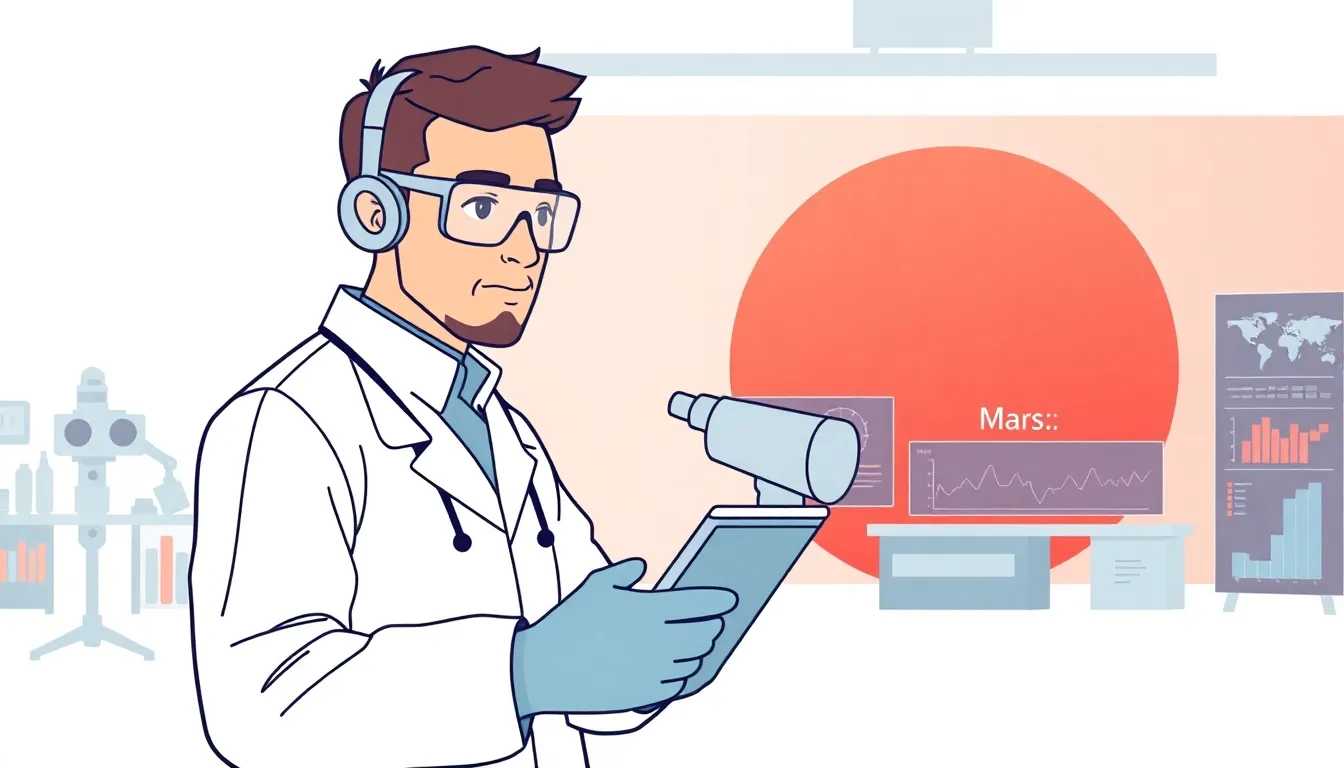
For decades, Mars has captured our imagination as the next frontier for human exploration. From science fiction novels to NASA missions, the Red Planet represents both our curiosity about the cosmos and our desire to expand beyond Earth. The question isn’t just can we go to Mars – we’ve already sent robots there – but can humans actually live there? Not just visit, but build homes, grow food, and raise families in an environment that seems determined to kill us at every turn. The technical challenges are enormous, but so is our determination to overcome them. Let’s explore what it would really take for humans to become Martians, and whether this dream might actually become reality within our lifetimes.
The Mars Environment: A Hostile New Home
Mars isn’t exactly welcoming to human life. The average temperature hovers around -80°F (-62°C), with wild swings from slightly warmer than freezing to -195°F (-125°C) at the poles. The atmosphere is 95% carbon dioxide and about 100 times thinner than Earth’s, meaning you’d need a pressure suit even if you could breathe the air – which you can’t. Radiation levels are significantly higher than Earth due to Mars’ weak magnetic field and thin atmosphere, exposing settlers to dangerous levels of cosmic rays and solar radiation.
Water exists on Mars, but not in readily accessible forms – it’s mostly frozen in the polar ice caps or bound up in the soil. The Martian soil itself contains perchlorates, toxic compounds that would need to be removed before growing any food. Dust storms can last for months, covering solar panels and potentially damaging equipment.
And let’s talk about gravity – Mars has about 38% of Earth’s gravitational pull. While floating around might sound fun, prolonged exposure to reduced gravity causes muscle atrophy, bone density loss, and other health problems we’re still studying through astronauts on the International Space Station.
Yet none of these challenges are necessarily deal-breakers. They’re problems to solve rather than reasons to abandon the dream.
🧐
Did You Know? A year on Mars lasts 687 Earth days, but a day (called a “sol”) is only slightly longer than Earth’s at 24 hours and 37 minutes. This means Martian colonists would experience seasons lasting nearly twice as long as those on Earth!
The Technical Challenges of Mars Settlement
Getting to Mars is just the first hurdle. The minimum distance between Earth and Mars is about 33.9 million miles, meaning even with our fastest rockets, the journey takes 7-9 months one-way. During that time, astronauts would face radiation exposure, potential health issues from microgravity, and psychological challenges from confinement with a small crew.
Once there, settlers would need to create habitats that protect from radiation, maintain pressure and temperature, recycle air and water, and provide food. Early settlements would likely be partially buried underground or covered with Martian soil (regolith) for radiation protection.
Energy production presents another puzzle. Solar power works on Mars – NASA’s rovers prove this – but dust storms can block sunlight for weeks or months. Nuclear power might be more reliable but comes with its own challenges for transport and maintenance.
Perhaps the biggest technical challenge is creating a self-sustaining colony that doesn’t require regular shipments from Earth. This means developing systems to:
- Extract oxygen from carbon dioxide (the MOXIE experiment on the Perseverance rover is already testing this)
- Mine water from subsurface ice deposits
- Grow food in controlled environments
- Manufacture tools and replacement parts
- Process Martian materials for construction
The technologies for all these systems exist in some form, but scaling them up for a Mars colony while making them reliable enough to bet human lives on? That’s the real challenge.
🧐
Did You Know? The pressure on Mars is so low (about 0.6% of Earth’s) that liquid water boils at approximately 50°F (10°C). This means that if you stood on Mars without a pressure suit, your saliva would boil in your mouth even before you froze or suffocated.
The Human Factor: Psychology and Physiology
Living on Mars isn’t just a technical problem – it’s a deeply human one. Settlers would face isolation from Earth like no humans have ever experienced. Communications would have a delay of 4-24 minutes each way, depending on the relative positions of Earth and Mars. No more real-time conversations with loved ones back home. No quick rescue if something goes wrong.
The psychology of isolation has been studied in Antarctic research stations and space missions, but Mars takes this to a new level. Settlers would need to cope with confinement, limited social contacts, and the knowledge that Earth is a tiny dot in the sky they might never return to.
Physically, the Martian environment presents long-term health concerns we’re still researching. Reduced gravity might lead to vision problems, cardiovascular issues, and bone density loss that could be permanent. Radiation exposure increases cancer risk significantly. Reproduction and child development in Martian gravity and radiation conditions remain complete unknowns.
Then there are ethical questions: Is it right to subject people to these risks? What about children potentially born on Mars who never consented to these conditions? Would humans born on Mars even be able to visit Earth with its crushing (to them) gravity?
These questions don’t have simple answers, but they’re crucial to consider alongside the technical challenges.
Timeframes and Possibilities
So when might humans actually live on Mars? The most optimistic projections from private companies like SpaceX suggest crewed missions might be possible in the 2020s or early 2030s. NASA’s plans target the 2030s or 2040s for human visits. But there’s a difference between visiting Mars and living there.
Initial missions would almost certainly be temporary – perhaps staying for a few weeks or months before returning to Earth. Establishing a permanent base might follow, similar to Antarctica’s research stations, with rotating crews staying for 1-2 years.
A true self-sustaining colony? That’s likely decades further out, possibly in the 2050s-2070s at the earliest. Such a colony would need to solve not just survival challenges but economic ones too. What would Mars export to justify the enormous investment? Scientific knowledge, certainly, but possibly also resources or intellectual property from innovations developed there.
The wild card in all these predictions is technological advancement. Breakthroughs in propulsion, radiation protection, closed-loop life support, or in-situ resource utilization could dramatically accelerate the timeline. Conversely, unexpected setbacks or shift in priorities could push it further into the future.
Conclusion: Mars as Humanity’s Insurance Policy
Whether humans will live on Mars isn’t just a question of technology – it’s a question of will. The technical problems, while formidable, appear solvable given enough time and resources. The bigger question is: will we commit to solving them?
There’s a compelling argument that we should. Stephen Hawking and others have suggested that becoming a multi-planetary species serves as an “insurance policy” for humanity. Earth has experienced mass extinction events before, and faces threats ranging from asteroid impacts to climate change to nuclear war. Having a second home for humanity helps ensure our species’ survival.
Beyond survival, Mars offers something else: a frontier. Throughout history, frontiers have driven innovation and provided opportunities for new social arrangements and fresh starts. Mars could represent humanity’s greatest adventure and a chance to apply what we’ve learned from Earth’s mistakes.
Will humans really live on Mars? If history is any guide, the answer is probably yes. Not because it’s easy, but precisely because it’s hard. The question isn’t if, but when – and what kind of society we’ll build there when we do.
Frequently Asked Questions
How much would it cost to send people to Mars?
Estimates vary widely, but NASA has suggested figures around $500 billion for a comprehensive Mars program. SpaceX claims they could do it for significantly less – perhaps $10 billion to develop the necessary spacecraft. Regardless of initial missions, establishing a self-sustaining colony would likely cost trillions over several decades. The economics might change dramatically if valuable resources are discovered or if space travel costs decrease significantly.
Could we make Mars more Earth-like through terraforming?
Theoretically yes, but the timeline would be measured in centuries or millennia with current technology. Terraforming would involve releasing greenhouse gases to warm the planet, creating a thicker atmosphere, and eventually introducing plants to produce oxygen. The main challenge is scale – Mars is an entire planet. Recent research suggests Mars may not have enough carbon dioxide locked in its polar caps and soil to create sufficient atmospheric pressure, even if it were all released.
What would be the legal status of Mars colonies?
This remains unclear. The 1967 Outer Space Treaty, signed by most spacefaring nations, prohibits any nation from claiming sovereignty over celestial bodies. However, it doesn’t specifically address what happens when people start living there permanently. New international agreements would likely be needed to establish governance frameworks for Mars settlements. Early colonies might operate similar to research stations in Antarctica or ocean vessels, with jurisdiction based on the nationality of the habitat or vehicle rather than territorial claims.